

Ocean dredging keeps shipping channels open, supports port construction, restores eroded shorelines and maintains the waterways that coastal communities depend on. The work looks simple on paper, since sediment is removed from one place and moved to another. In practice, it relies on a carefully matched set of machines, vessels and support systems.
This article explains the main equipment categories used in ocean dredging operations, how each one works and where each fits best. It also looks at the growing role of an amphibious excavator in marine dredging, particularly where water is shallow, the seabed is soft and large vessels cannot easily operate. Wilco Marsh Buggies designs, rents and sells amphibious equipment for this kind of work, so the shallow water and soft ground side of dredging is covered in some detail.
What Is Ocean Dredging?
Dredging is the excavation of sediment, sand, silt, clay or debris from the bottom of a water body. In ocean and coastal settings, the main goals are usually:
-
Deepening or maintaining navigation channels and harbor basins
-
Supplying sand for beach nourishment and coastal protection
-
Clearing sediment from intake structures, outfalls and berths
-
Removing contaminated or unwanted material from the seabed
-
Preparing trenches for pipelines, cables and foundations
No single machine suits every job. Water depth, sediment type, wave exposure, disposal distance and environmental limits all shape equipment choice. Because of this, a typical project combines a primary dredging unit with transport, positioning and monitoring equipment.
Main Types of Dredgers Used at Sea
Trailing Suction Hopper Dredgers
A trailing suction hopper dredger is a self-propelled ship equipped with a suction pipe that trails along the seabed as the vessel moves. During ocean dredging, sediment is drawn up through the pipe and stored in an onboard hopper. Once the hopper is full, the vessel sails to a disposal or reclamation site, where it either releases the load through bottom doors or pumps it ashore.
These vessels are commonly used for ocean dredging in open waters because they can keep moving and operate in areas with passing vessel traffic. They are widely used for channel maintenance and collecting sand for coastal protection and reclamation projects.
Cutter Suction Dredgers
A cutter suction dredger uses a rotating cutter head at the end of a suction pipe to loosen compacted material, which is then pumped through a pipeline. The dredger is usually held in place with spud poles and swings on anchors or cables to cover the work area.
This design is suited to harder or more cohesive material, including stiff clay and soft rock. It is often used for new channel construction, harbor deepening and land reclamation where the pipeline can reach the disposal area.
Backhoe and Grab Dredgers
A backhoe dredger is a barge fitted with a large hydraulic excavator mounted on the deck and held in position by spud poles. Grab or clamshell dredgers use a bucket lowered on a cable to lift material from the bottom.
These units give precise control over where material is removed. They work well in confined areas such as quay walls, berths and harbor corners, and they can handle debris, rubble and mixed sediment.
Bucket Ladder and Dipper Dredgers
Bucket ladder dredgers use a continuous chain of buckets to scoop material, while dipper dredgers use a large shovel on a rigid arm. Both are less common than they once were, but they still appear on certain projects involving hard or rocky material.
Support Equipment That Keeps Dredging Moving
The dredger is only part of the operation. Several supporting machines keep the project efficient and accurate.
Split Hopper Barges and Scows
Barges carry dredged material from the work area to a placement or disposal site. Split hopper barges open along the keel to release their load, which saves time when the haul distance is short. Flat scows are also used with grab and backhoe dredgers.
Tugboats and Workboats
Tugs move barges, reposition dredgers, handle anchors and move floating pipelines. Smaller workboats carry crew, run survey tasks and handle lines and buoys.
Pipelines and Booster Pumps
Where sediment is pumped to shore, a floating and submerged pipeline system carries the slurry. Booster pumps are added along the line when the distance or elevation increases. The pipeline layout needs planning to avoid navigation hazards and to protect sensitive habitat.
Survey and Positioning Systems
Accurate dredging depends on good data. Multibeam echosounders map the seabed before and after dredging. GNSS positioning and tide gauges give precise location and water level information. Many dredgers display this data in real time so operators can stay within the design depth and avoid over-dredging.
Environmental Controls
Silt curtains, turbidity monitors and sediment sampling tools help limit the spread of suspended material and confirm that water quality targets are met. Regulations often set strict conditions, so this equipment is part of the standard project package.
The Role of Amphibious Equipment in Marine Dredging
Large dredging vessels need depth to float and room to maneuver. Many coastal areas do not offer either. Shallow bays, tidal flats, marsh edges, canals and lagoons often sit in water too shallow for a hopper dredger and on ground too soft for a conventional excavator.
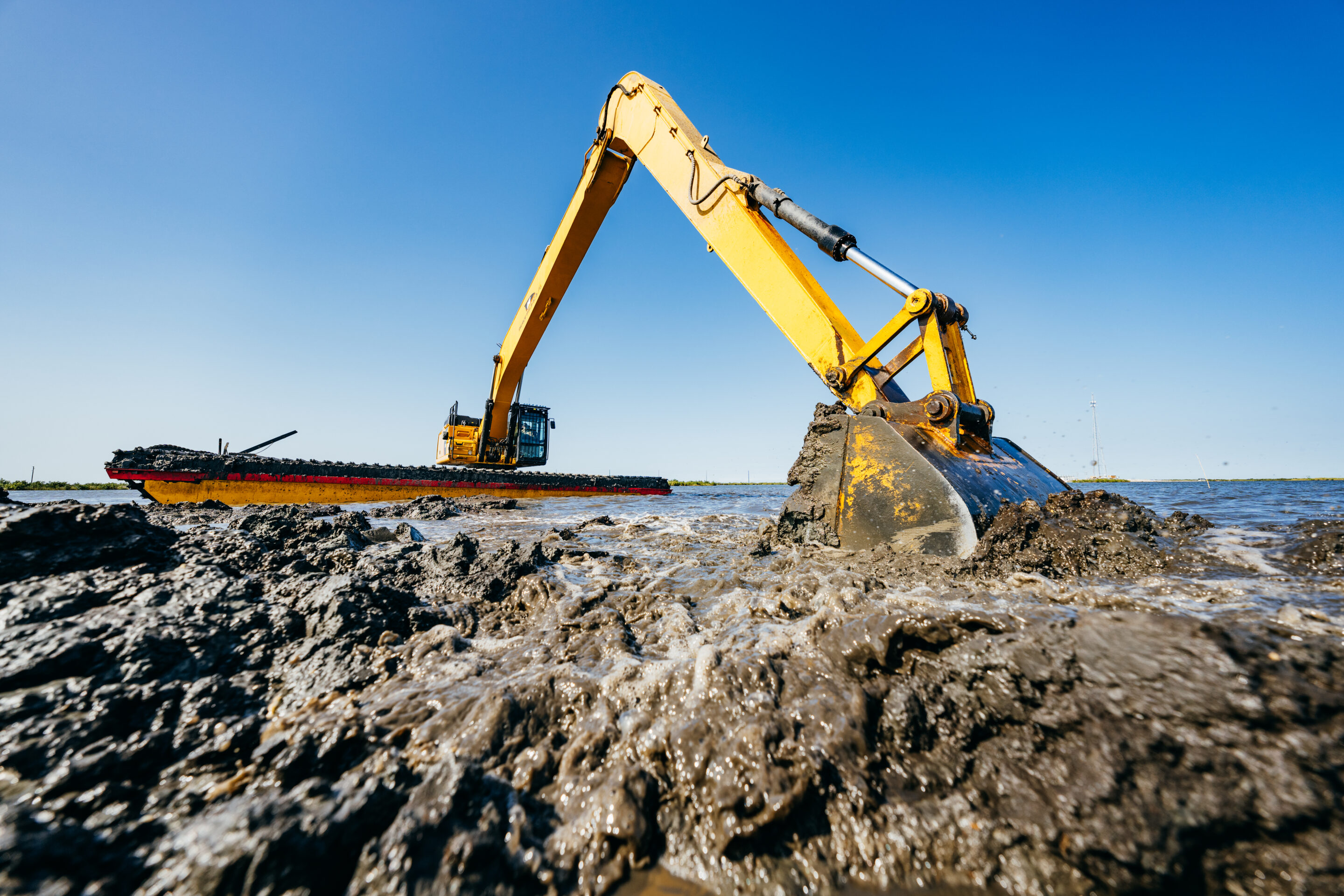
This is where an amphibious excavator marine dredging setup becomes useful. An amphibious excavator is a standard excavator mounted on a pontoon or buoyant undercarriage. The machine can float, walk across soft ground and dig from the same platform, so it moves between land and water without needing a separate barge or access road.
Many contractors use the term amphibious marine dredging equipment to describe this group of machines, which includes pontoon excavators, marsh excavators and marsh buggies. They are not a replacement for a large dredging vessel in open water. They fill the gap where large vessels cannot work, and they are especially valuable close to shore. For a deeper look at how this works in practice, the benefits of amphibious excavators in dredging projects are covered in more detail.
Where an Amphibious Excavator Fits in Coastal Dredging
An amphibious excavator coastal dredging operation tends to suit work such as:
-
Clearing sediment from shallow channels and tidal creeks
-
Maintaining drainage canals and stormwater outfalls
-
Removing silt around docks, boat ramps and small harbors
-
Rebuilding marsh edges and shoreline features
-
Placing dredged material in nearby containment areas
Because the machine spreads its weight over a large floating surface, ground pressure stays low. This reduces damage to soft shorelines and fragile vegetation, which matters on coastal projects with environmental conditions attached.
Common Configurations
Amphibious excavators can be fitted with different attachments depending on the task:
-
Standard buckets for general excavation
-
Long reach booms for working across wider channels
-
Excavator-mounted dredge pumps for hydraulic dredging
-
Mulching or cutting heads for vegetation control
-
Grapples for debris removal
A long reach arm lets the machine work well away from the pontoons, and a dredge pump attachment can move slurry through a pipeline to a nearby placement area. This flexibility is one reason that amphibious equipment appears on projects of very different sizes.
Wilco Marsh Buggies supplies amphibious excavators, long reach equipment and custom amphibious undercarriages for contractors working in shallow water and soft terrain. Projects of this kind often begin with a basic question about whether the site calls for a large vessel, an amphibious machine or a combination of both. The comparison below shows how the main equipment types differ.
Comparing Common Ocean Dredging Equipment
| Equipment | Primary Function | Typical Conditions | Common Applications |
|---|---|---|---|
| Trailing suction hopper dredger | Suction and onboard storage of loose sediment | Open water, sand and silt, moderate to deep depth | Channel maintenance, beach nourishment |
| Cutter suction dredger | Cutting and pumping compacted material | Harder soils, fixed work area, pipeline access | New channels, reclamation, harbor deepening |
| Backhoe dredger | Precise excavation from a spud barge | Confined areas, mixed or debris-filled sediment | Berths, quay walls, trench work |
| Grab or clamshell dredger | Vertical lifting of material | Deep or restricted spaces | Foundation pits, harbor corners |
| Amphibious excavator | Digging and dredging from a floating platform | Shallow water, soft ground, marsh and shoreline | Canals, tidal creeks, shoreline work |
| Split hopper barge | Transport and release of dredged material | Short to medium haul distances | Disposal and placement |
| Tugboat | Towing and positioning | All marine work | Barge and pipeline handling |
The table shows that each machine has a defined zone of use. Large vessels handle volume and depth, while backhoe and grab units add precision. Amphibious machines cover shallow and soft sites that other equipment cannot reach safely.
How to Choose the Right Dredging Equipment
Equipment selection should start with site data rather than machine preference. A few questions usually decide the matter.
Water Depth and Access
Hopper and cutter suction dredgers need enough draft to float, while amphibious machines work in much shallower water. Surveying the bathymetry first prevents the common mistake of sending a vessel to a site where it cannot operate.
Sediment Type
Loose sand and silt can be pumped easily. Stiff clay, rock or debris may need a cutter head or a bucket. Sediment sampling gives a clear picture of what the equipment will face.
Wave Exposure and Weather
Open ocean sites bring swell, wind and current. Larger vessels cope better with exposed conditions, while amphibious excavators perform best in sheltered or shallow coastal settings. Many projects schedule work around weather windows to keep crews and equipment safe.
Disposal and Placement
Whether sediment is pumped, hauled or placed nearby affects the number of barges, pipelines and pumps required. Short, local placement often suits amphibious dredging, since the material can be moved with a dredge pump or placed directly.
Environmental Conditions
Permits often limit turbidity, work seasons and habitat disturbance. Low ground pressure, precise digging and the ability to work without building temporary roads can make amphibious equipment a good match. A closer look at how amphibious excavators operate in water and wetlands shows how these machines handle sensitive sites.
Many projects use a mix. A large vessel may handle the main channel, and an amphibious excavator may clean up the shallow margins, tidal creeks and shoreline edges that the vessel cannot reach.
Safety and Maintenance Considerations
Dredging involves heavy machinery, moving water and changing conditions, so safety planning is essential. Crews should follow site-specific procedures for lifting, anchoring, working near pipelines and operating around other vessels. Daily inspections of hydraulic lines, pontoons, tracks and engine systems help prevent downtime.
Amphibious excavators need particular attention to flotation components, since pontoon integrity affects stability. Regular servicing of the undercarriage, hydraulic system and cooling components keeps the machine reliable in wet, abrasive and salty conditions. Operators also need training in floating work, including how weight distribution changes when the boom extends.
Environmental Responsibility in Dredging
Good dredging practice protects the water body as well as clearing it. Teams commonly plan for turbidity control, track dredged volumes and place material where it supports a beneficial purpose, such as marsh rebuilding or beach nourishment. Equipment that leaves a smaller footprint helps meet these goals. For projects that include habitat work near the shoreline, the use of an amphibious excavator for wetland restoration is one approach that pairs excavation with low-impact access.
Conclusion
Ocean dredging draws on many types of equipment, from trailing suction hopper dredgers and cutter suction units to barges, pipelines and survey systems. Each has a place, and the best results come from matching the machine to the depth, sediment and environmental conditions of the site. Where water is shallow and the ground is soft, amphibious marine dredging equipment gives crews access that larger vessels cannot, and an amphibious excavator can handle a wide range of near-shore tasks.
Wilco Marsh Buggies provides amphibious excavators and related equipment for contractors working in these demanding conditions. If you are planning a dredging project and want to discuss equipment options, contact our team to talk through your site and requirements.
Frequently Asked Questions
1. What equipment is most commonly used in ocean dredging?
Trailing suction hopper dredgers, cutter suction dredgers and backhoe dredgers are the most common primary units. They are supported by barges, tugboats, pipelines, pumps and survey systems.
2. Can an amphibious excavator be used for marine dredging?
Yes, within limits. An amphibious excavator is well suited to shallow water, canals, tidal creeks and shoreline areas. It is not designed for deep open ocean channels, where large dredging vessels are the standard choice.
3. What is the difference between an amphibious excavator and a backhoe dredger?
A backhoe dredger is a barge carrying an excavator and is held in place by spud poles. An amphibious excavator has the floating system built into its undercarriage, so it can also walk across soft ground and move between land and water.
4. Is amphibious equipment suitable for coastal dredging projects?
It can be, particularly for sheltered or shallow areas. Amphibious excavator coastal dredging is often chosen for canals, marsh edges, small harbors and shorelines where large vessels and conventional machines cannot work.
5. What attachments can amphibious dredging equipment use?
Common options include standard buckets, long reach booms, dredge pumps, grapples and vegetation cutting heads. The right choice depends on sediment type, water depth and the way material will be placed.
6. How do I know which dredging equipment my project needs?
Start with water depth, sediment type, exposure and disposal method. A site survey and sediment sampling give the information needed to match equipment to conditions.