

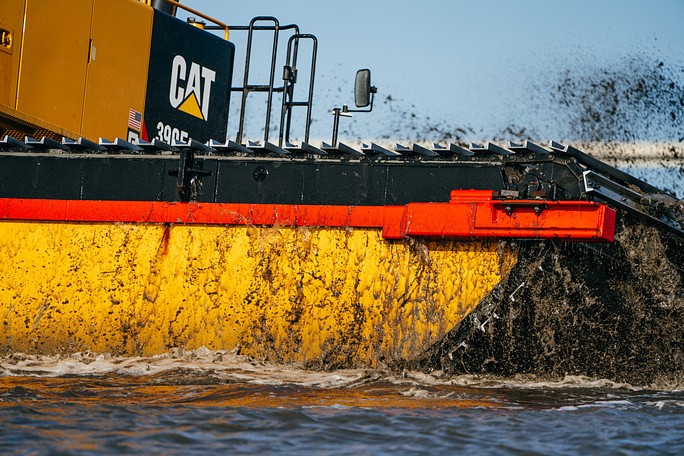
Working near lakes, canals, marshes, and coastal wetlands puts crews and equipment in conditions that standard machinery was never built to handle. Soft mud, shallow water, and unstable banks turn ordinary excavation into a serious safety concern. A floating excavator addresses these risks directly by combining stable flotation with the digging capability of a standard excavator, so crews can work over water and soft ground without the constant threat of sinking, tipping, or getting stuck.
This article looks at how a pontoon excavator changes the safety profile of water construction work, what risks it reduces, and how it compares to conventional equipment on marsh, swamp, and wetland sites.
What Is a Floating Excavator?
A floating excavator, also called a pontoon excavator or amphibious excavator, is a standard excavator mounted on a set of large pontoons instead of conventional tracks or wheels. The pontoons displace enough water to keep the machine buoyant, while onboard propulsion systems allow it to move through water, mud, and soft sediment that would trap a normal excavator within minutes.
Unlike a barge-mounted excavator, which depends on a separate floating platform, an amphibious digger is self-propelled. It can move independently between work zones, climb onto banks, and transition between land and water without additional lifting or towing equipment.
How a Pontoon Excavator Differs from a Standard Machine
A conventional excavator relies on tracks that need firm ground to distribute weight. On saturated soil or in shallow water, those tracks lose traction and the machine can sink or roll. A pontoon excavator spreads its weight across large, sealed floats, which lowers ground pressure and keeps the machine level even on soft or submerged terrain. This structural difference is the main reason floating equipment is considered safer for wetland, marsh, and open water projects.
Common Safety Risks in Water and Wetland Construction
Before looking at how amphibious excavators help, it is worth understanding the hazards they are designed to reduce:
-
Equipment tipping or capsizing on uneven, submerged ground
-
Machines becoming stuck in mud, requiring risky recovery operations
-
Workers entering water or soft ground manually to guide equipment or clear obstructions
-
Reduced visibility and unstable footing during dredging or bank clearing
-
Damage to equipment stability caused by shifting sediment under tracks
Each of these risks increases both the chance of injury and the cost of a delayed project. Choosing the right equipment from the start is one of the more effective ways to manage them.
How Floating Excavators Improve Safety
Stable Flotation Reduces Rollover Risk
The pontoons on an amphibious excavator are engineered to keep the machine level regardless of how uneven or soft the underlying ground is. Because the load is spread across a wide flotation surface rather than concentrated under narrow tracks, the risk of tipping on soft banks or submerged slopes is significantly lower than with a wheeled or tracked machine.
Reduced Need for Manual Labor in Hazardous Water
One of the more overlooked safety benefits of a floating excavator is how much manual work it removes from the equation. On sites without amphibious equipment, crews sometimes need to enter shallow water or unstable mud to guide machinery, clear debris, or assist with recovery when equipment gets stuck. An amphibious excavator can perform these tasks from the cab, keeping operators out of the water and away from unstable footing.
Reach and Visibility Improvements with Long Reach Amphibious Excavators
Many water construction projects, including canal maintenance and shoreline dredging, require the machine to work at a distance from solid ground. A long reach amphibious excavator extends the boom and arm length so the operator can dig, clear, or lift material without moving the machine closer to unstable banks or deeper water. This keeps the equipment on more stable footing while still completing work at the required distance.
Wilco Marsh Buggies builds and configures amphibious excavators for exactly these conditions, matching pontoon size, reach, and horsepower to the specific ground and water conditions of a project.
Floating Excavator vs Traditional Excavator: Safety Comparison
| Safety Factor | Standard Excavator | Floating Excavator |
|---|---|---|
| Ground pressure | High, concentrated under tracks | Low, spread across pontoons |
| Stability on soft or submerged ground | Poor, risk of sinking or tipping | Strong, designed for water and mud |
| Manual worker exposure to water | Often required for guidance or recovery | Minimal, most tasks handled from the cab |
| Recovery if stuck | Difficult, may need cranes or additional machines | Rare, equipment is built to move through soft terrain |
| Reach into water without repositioning | Limited | Extended with long reach amphibious excavator models |
| Suitability for marsh or swamp excavator work | Not designed for it | Purpose-built for it |
Applications of Amphibious Diggers in Water Construction
Aquatic excavators are used across a range of water and wetland projects where safety and access are equally important:
-
Canal and waterway dredging to maintain depth and flow
-
Marsh and wetland restoration, including sediment placement and vegetation clearing
-
Pipeline and utility installation across soft or flooded ground
-
Shoreline and levee maintenance
-
Environmental cleanup in swamp and marsh environments where standard equipment cannot safely operate
Because a marsh excavator is built to handle both the digging task and the unstable ground beneath it, these projects can move forward without exposing crews to the risks of manual water work or equipment recovery operations.
Buying vs Renting: Floating Excavator for Sale or Floating Excavator Rental
Contractors approaching water construction work for the first time often need to decide between purchasing equipment outright or arranging a floating excavator rental for a specific project. Each option affects safety planning differently.
Buying makes sense for companies with ongoing wetland, marsh, or dredging work, since it allows the equipment to be maintained, inspected, and configured consistently over time. Businesses researching a pontoon excavator for sale or an amphibious excavator for sale should confirm that the machine’s pontoon size and reach match the water depth and ground conditions of their typical job sites, since an undersized unit reduces the safety margin the flotation system is meant to provide.
Renting is often the more practical choice for a single project, seasonal work, or a job where ground conditions are unfamiliar. A floating excavator rental or amphibious excavator for rent arrangement also gives contractors access to a properly sized machine, including a mini amphibious excavator for tighter or shallower sites, without the long-term cost of ownership. For larger or more remote sites, a long reach amphibious excavator can be rented specifically to reduce how often the machine needs to reposition near unstable banks.
Choosing the Right Amphibious Excavator for Your Project
Not every wetland or water job requires the same configuration. A few factors typically guide the decision:
-
Water depth and ground saturation. Deeper water or heavily saturated soil generally calls for larger pontoons to maintain stability.
-
Reach requirements. Projects that involve working at a distance from the bank, such as canal dredging, benefit from a long reach amphibious excavator.
-
Site size and access. Tighter marshes or narrower waterways may be better suited to a mini amphibious excavator that can maneuver in confined spaces.
-
Project duration. Short-term jobs often favor rental, while ongoing operations may justify a purchase.
Matching the machine to these conditions is one of the most direct ways to keep a project both efficient and safe.
Conclusion
Water and wetland construction sites carry safety risks that standard equipment is not built to handle. A floating excavator addresses those risks directly, from reducing rollover potential to keeping workers out of hazardous water. Whether a project calls for a compact mini amphibious excavator, a long reach amphibious excavator, or a full marsh excavator setup, choosing equipment that matches the ground and water conditions is one of the most effective ways to protect both crews and timelines.
Wilco Marsh Buggies has decades of experience building and supporting amphibious excavators for marsh, swamp, and open water construction projects. Whether you are exploring a floating excavator for sale, comparing amphibious excavators for sale, or looking into a floating excavator rental for an upcoming job, our team can help match the right equipment to your site conditions. Contact us today to discuss your project.
FAQ
1. What makes a floating excavator safer than a standard excavator on water sites?
A floating excavator uses pontoons to spread its weight across a wide surface area, which lowers ground pressure and keeps the machine stable on soft or submerged ground where a standard excavator would be at risk of sinking or tipping.
2. Can a floating excavator work on both land and water?
Yes. Most amphibious excavators are designed to transition between water, mud, and solid ground, which is why they are also referred to as amphibious diggers.
3. What is the difference between a swamp excavator and a marsh excavator?
The terms are largely interchangeable in the industry. Both describe amphibious excavators built specifically for soft, saturated ground found in swamps and marshes, using pontoons instead of standard tracks.
4. Is it better to rent or buy an amphibious excavator?
It depends on how often the equipment will be used. A single project or seasonal work usually favors a floating excavator rental, while contractors with recurring wetland or marsh projects often find that purchasing is more cost effective over time.
5. How far can a long reach amphibious excavator extend?
Reach varies by model and configuration, but long reach amphibious excavators are specifically built with extended booms and arms to work farther from the bank without repositioning the machine, which helps maintain a stable base during operation.